

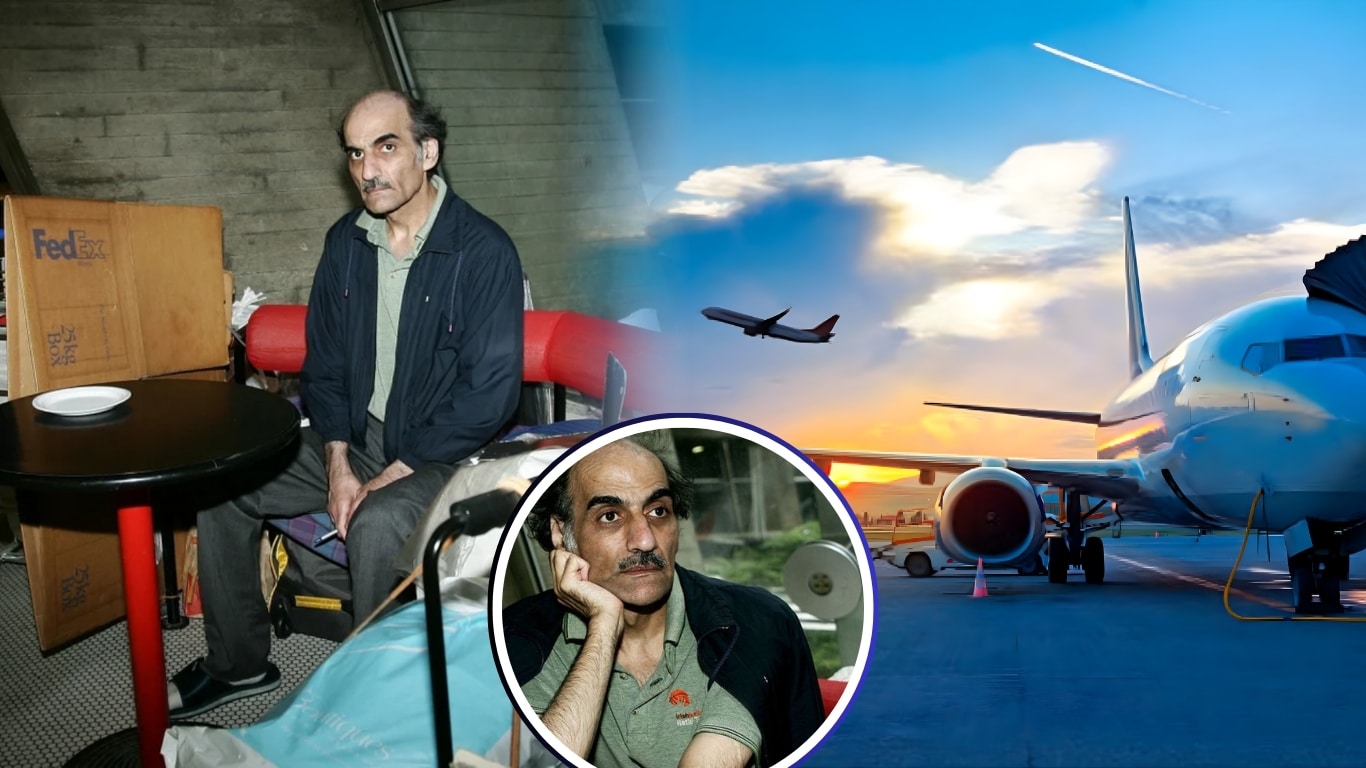
Most of us can’t stand a long layover at the airport — a few hours feels like a lifetime. But one man spent nearly two decades living inside the terminal of one of Europe’s busiest airports. His extraordinary story sounds like something out of a movie… and in fact, it inspired one.
This is the true story of Mehran Karimi Nasseri, a refugee whose life was transformed into 18 years of airport life at Charles de Gaulle Airport in Paris — all because of a missing travel document.
🤯 How It All Began: Stuck in Limbo Because of Lost Papers
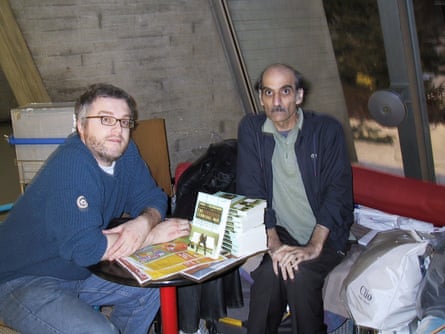
Nasseri’s story starts not with adventure, but bureaucratic chaos.
Born in Iran in 1945, Mehran Karimi Nasseri had been seeking a better life in Europe. He had refugee papers and was trying to reach the United Kingdom — but when he arrived at Charles de Gaulle Airport in Paris in 1988, something went terribly wrong.
According to official records, his refugee documents were lost or allegedly stolen — accounts vary on exactly how — and without them, he couldn’t legally enter France or travel onward. Because he had no valid passport or identification papers, immigration authorities refused to let him leave the airport.
In Europe, entering a country without proper documentation can mean detention, deportation, or immediate return to the point of departure. But in Nasseri’s case, no country would accept him because he lacked identification — leaving him trapped in a sort of legal no‑man’s‑land inside the airport itself.
🏨 Turning the Airport Into a Home
Once stuck in the airport’s international transit zone, Nasseri couldn’t board a plane without papers, couldn’t go into France without them, and couldn’t return to Iran — meaning he was literally nowhere.
So instead of leaving, he stayed.
Over time, the departure lounge of Terminal 1 at Charles de Gaulle became his home. For years — 18 years in total, from 1988 to 2006 — he slept on benches, carried his luggage with him, and lived entirely inside the airport’s terminals.
Passengers and airport staff came to recognize him. Some supplied food, newspapers, or conversation. Others passed through his familiar corner without realizing he would still be there decades later.
He had no fixed residence, no legal identity papers he could present elsewhere, and no way to simply walk out the front door into French territory. That impossible situation turned a transient space into his long‑term residence.
📚 Life Behind the Terminals

Although many might imagine his life as chaotic or aimless, Nasseri tried to bring structure to his unusual situation. During his airport years:
-
He kept a journal, documenting his thoughts and experiences.
-
He read newspapers and magazines that passengers discarded or gave him.
-
Locals said he studied economics, listened to the radio, and smoked a gold pipe as part of his routines.
-
He sometimes ate meals bought for him by caring travelers.
Despite being surrounded by hundreds of thousands of people passing through daily, he had no permanent social circle — yet the airport became his world.
🎬 Inspiration for Hollywood — But Reality Was Stranger

Nasseri’s incredible story caught international attention and became the inspiration for Steven Spielberg’s 2004 film The Terminal starring Tom Hanks — although Hollywood made many changes for dramatic effect.
In reality, Nasseri’s airport life wasn’t a romantic adventure — it was a long, bewildering session of bureaucratic limbo driven by his lack of paperwork and complicated by immigration laws.
Though offered refugee documents from France and Belgium at various points, he refused to sign them because they didn’t list his preferred name or nationality — a choice that extended his stay even further.
🧠 A Life Defined by Borders and Bureaucracy

In many ways, Nasseri’s situation demonstrates how modern immigration systems can trap people inside legal gray zones. He wasn’t in prison — he was free to move within the airport terminal — yet he couldn’t go anywhere else.
For years, aviators and travelers would glimpse him on the benches, sometimes smoking a pipe or writing, always surrounded by luggage that likely contained more than just his belongings — it held his hopes, identity, and story.
🏁 His Final Days and Legacy
Nasseri’s 18‑year residency finally ended in July 2006, when he was hospitalized and moved out of the airport after being offered aid.
He later lived in charity accommodations in Paris, but according to reports, he eventually returned to the airport shortly before his death. In November 2022, he passed away at Charles de Gaulle — the place that had become, for better or worse, his lifelong home.
🌍 A Story That Is Stranger Than Fiction
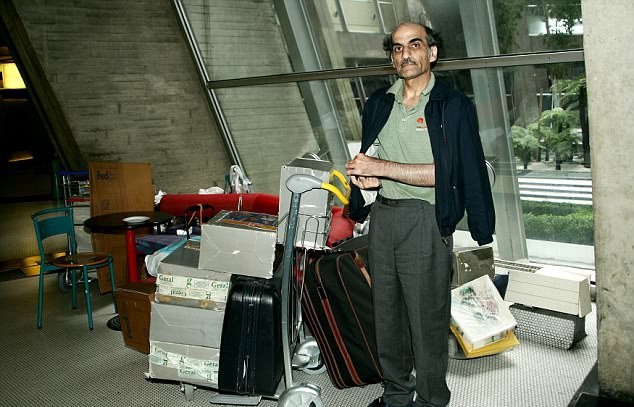
Mehran Karimi Nasseri’s life — a man who made an airport his home for nearly two decades — stands as a profound reminder of how bureaucracy, identity, and belonging can intersect in ways no one could imagine. His story speaks to human resilience, bureaucratic absurdity, and the strange places life can take us when we’re stuck between borders.
Few cases in history blend human tragedy and surreal persistence like Nasseri’s — a man who lived among travelers yet never truly traveled again.
