

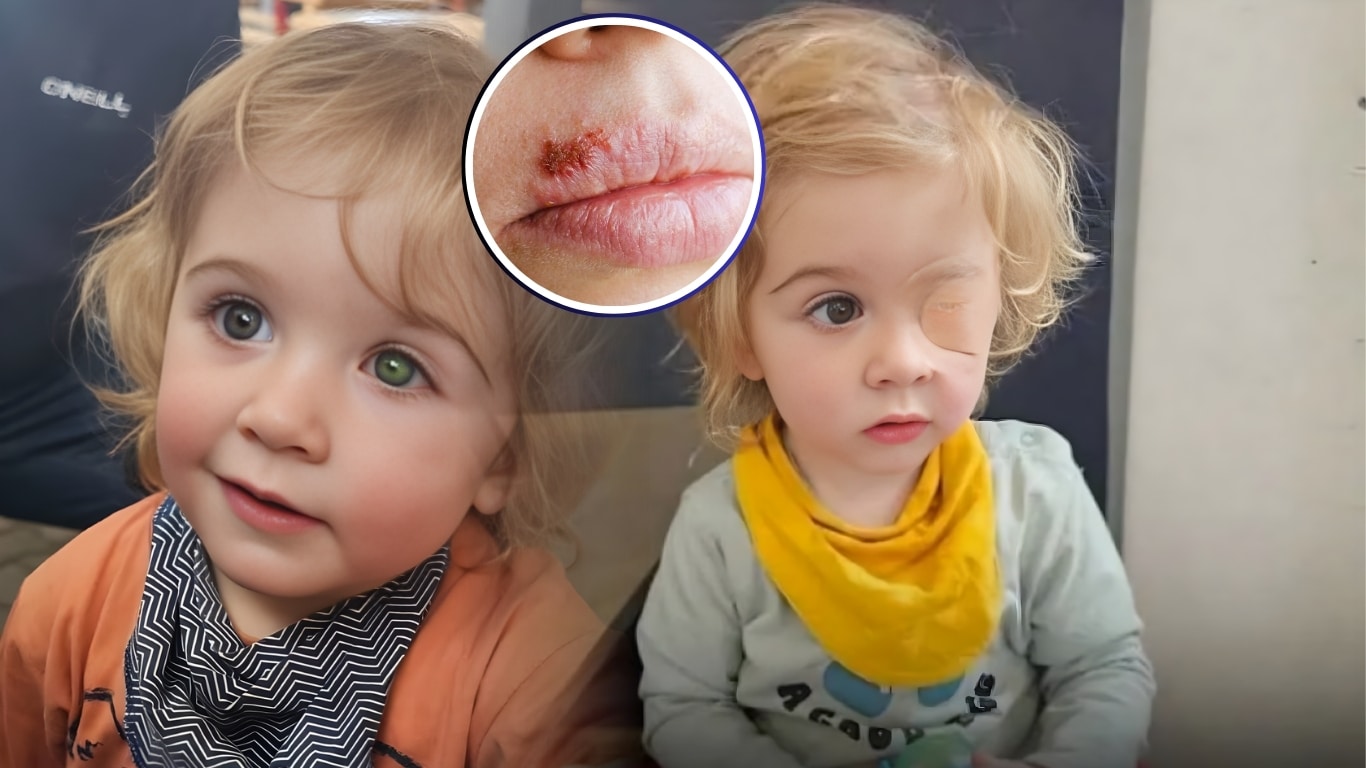
In a story that has shocked parents and health experts across the world, a two‑year‑old boy has lost vision in one eye after contracting the herpes simplex virus (HSV‑1) from a kiss — a virus most people associate with cold sores, not devastating eye damage. His mother is now issuing a powerful warning to families everywhere about the potentially serious risks of close contact when someone carries an active infection.
A Mother’s Worst Nightmare

The boy, named Juwan, was living in the United Kingdom when what first appeared to be a typical eye infection rapidly turned into a medical crisis. What initially seemed like redness and irritation soon escalated to something far more serious, leading his parents to seek repeated medical attention.
Despite being prescribed antibiotic eye drops, his condition worsened. Within days, the boy’s eye developed what doctors later described as an open wound and he lost sensation in the affected eye — a sign that the damage was deeper than a common bacterial infection.
Eventually, further examinations revealed a surprising diagnosis: herpes simplex virus had infected his eye, making it one of the rare but dangerous forms of herpes keratitis — an infection of the cornea caused by HSV.
How Herpes Can Infect the Eye
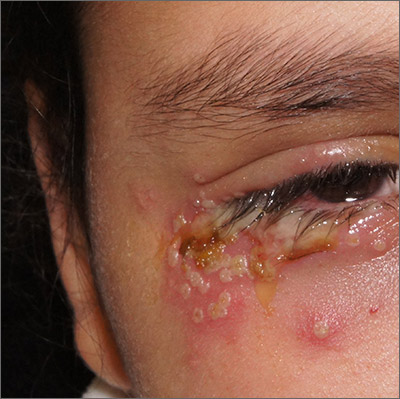
Herpes simplex virus type 1 (HSV‑1) most often causes cold sores around the mouth. It’s highly contagious and spreads through direct contact with infected saliva or skin. While many people carry the virus without severe consequences, in some cases — especially in young children with developing immune systems — it can travel from a person’s mouth or lips to their eye, leading to infection.
When HSV infects the eye — a condition known as herpes simplex keratitis — it attacks cells in and around the cornea. This can lead to:
-
Pain and redness
-
Blurry vision
-
Ulceration of the corneal surface
-
Scarring
-
Loss of sensation
-
Permanent vision loss in severe cases
In Juwan’s case, doctors believe the virus was transmitted when someone with active cold sores kissed him near or on his face — possibly even close to his eye. Because both parents tested negative for the virus, the infection most likely came from someone outside the immediate family.
A Rapidly Worsening Condition

The damage in the toddler’s eye progressed quickly. Juwan’s cornea developed an approximately 4 mm open defect, leaving his eye constantly infected and without normal sensation — meaning he could touch it without any pain. This lack of reflex protection is dangerous because it makes the eye vulnerable to further injury and infection.
The ongoing infection and tissue destruction resulted in complete vision loss in that eye. His brain began to disregard signals from the damaged eye, effectively “turning off” visual processing from that side.
Fighting for Sight: Surgeries and Hope

The family did not give up. After initial treatment attempts in the UK, they traveled to South Africa for specialist care. Juwan has undergone multiple surgeries in hopes of saving his eye and possibly restoring some function.
Part of this process includes a highly specialized procedure to transfer nerves from his leg into the eye socket in an attempt to restore sensation and prepare the eye for a potential corneal transplant if a donor can be found.
However, the outcome remains uncertain. Even with aggressive medical intervention, the extent of the permanent damage to his eye means his future vision could still be limited.
What Makes Eye Herpes So Dangerous?
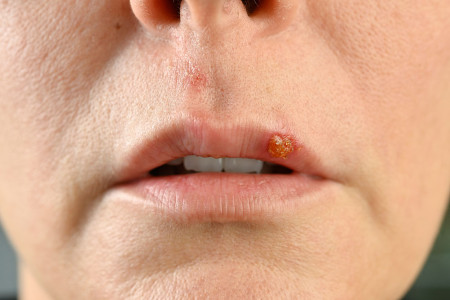
Eye infection from HSV‑1 is not common, but it’s one of the leading viral causes of corneal blindness worldwide. The virus initially infects the surface cells of the eye and can then spread to deeper nerve cells. Even with treatment, scarring and persistent damage can make irreversible vision loss likely.
Unlike a cold sore on the lip, which typically heals on its own, ocular herpes can be far more serious due to the vulnerability of eye structures and the delicate nature of corneal tissue. If not treated promptly by specialists, herpes infections can also lead to secondary complications such as retinal inflammation or detachment.
A Parent’s Warning to the World

Juwan’s mother has been open about her family’s ordeal, urging other parents to be vigilant about who has close contact with their young children — especially when someone shows signs of an active herpes infection. Her message is stark: even something as seemingly harmless as a kiss can lead to life‑altering consequences.
Health professionals also emphasize that people with visible cold sores should avoid close facial contact, sharing utensils, or exposing children to saliva when lesions are present — because HSV‑1 can be transmitted even when symptoms are subtle.
Key Takeaways
-
Herpes simplex virus type 1 can infect the eye, leading to serious complications such as herpetic keratitis, scarring, and vision loss.
-
Young children are especially vulnerable to severe outcomes due to developing immune systems and behavior that may expose them more easily to infection.
-
Immediate medical care with antiviral therapy and specialist ophthalmic support is critical to limit damage.
-
Minimizing exposure to HSV‑1 — especially avoiding kisses on or near the face from individuals with active sores — can reduce risk.
